Is No Cost EMI Really Free? The Ultimate Guide to Hidden GST & Bank Charges (2026)
Is No Cost EMI really free? Discover the hidden GST on interest, processing fees, and new 2026 bank charges that increase your real EMI cost.
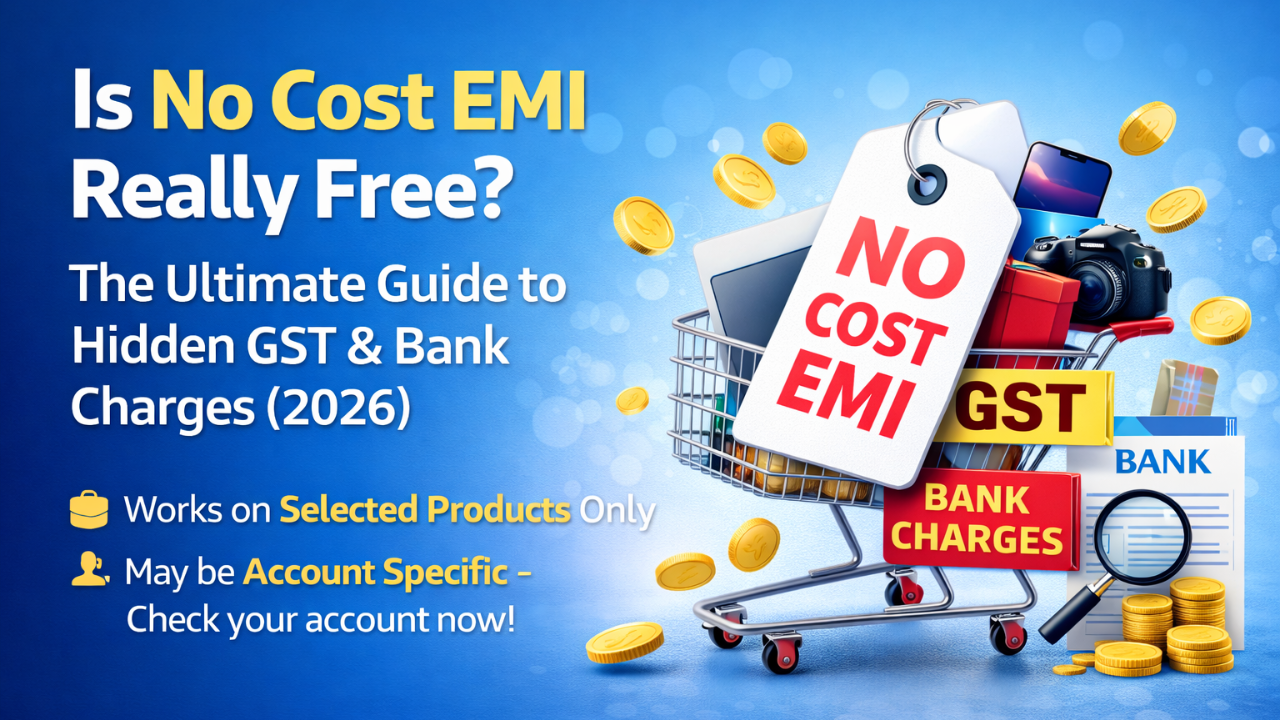
Is No Cost EMI Really Free? The Ultimate Guide to Hidden GST & Bank Charges (2026)
Whenever we browse Amazon or Flipkart, the "No Cost EMI" tag looks like a financial miracle. It promises that you can take home the latest iPhone or a premium laptop and pay the exact sticker price over 6 to 12 months with 0% interest.
But as a smart consumer, you must ask: Why would a bank give you money for free?
Today, we are pulling back the curtain on the "No Cost EMI" trap. Using real-world amortization logic and recent bank service fee revisions, here’s why your "free" EMI actually has a hidden price tag.
The Illusion: What E-commerce Sites Show You
When you select No Cost EMI, the math shown at checkout is very simple. For a purchase of ₹59,900, the table looks like this:
| Item | Calculation | Total |
|---|---|---|
| Product Price | ₹59,900 | ₹59,900 |
| Tenure | 6 Months | — |
| Monthly EMI | ₹59,900 / 6 | ₹9,983.33 |
On the surface, you aren’t paying a single rupee extra. But the real game happens behind the scenes in your credit card statement.
The Reality: How No Cost EMI Actually Works
- The bank does charge interest (usually 14%–16%).
- To make it "No Cost," the merchant gives you an upfront discount equal to that interest.
- The Trap: The Government charges 18% GST on that interest, and this GST is not discounted.
Data Breakdown: Example Amortization Structure
Let’s look at a simplified breakdown for a ₹59,900 purchase at 15.99% interest.
Standard View (Marketing)
- Total Principal Paid: ₹57,202.78
- Total Interest Paid: ₹2,697.22
- Final Statement Amount: ₹59,900
The Hidden Reality (GST & Fees)
| Month | Principal | Interest (15.99%) | GST (18%) | Real Monthly Outflow |
|---|---|---|---|---|
| Month 1 | ₹9,221.10 | ₹762.23 | ₹137.20 | ₹10,120.53 |
| Month 2 | ₹9,343.97 | ₹639.36 | ₹115.08 | ₹10,098.41 |
| Month 3 | ₹9,468.48 | ₹514.85 | ₹92.67 | ₹10,076.00 |
| Month 4 | ₹9,594.65 | ₹388.68 | ₹69.96 | ₹10,053.29 |
| Month 5 | ₹9,722.50 | ₹260.83 | ₹46.94 | ₹10,030.27 |
| Month 6 | ₹9,852.08 | ₹131.27 | ₹23.62 | ₹10,006.97 |
| Total | ₹57,202.78 | ₹2,697.22 | ₹485.49 | ₹60,385.49 |
Key Takeaway: You paid ₹485.49 extra just in GST. Add a processing fee (for example ₹199 + GST), and your "No Cost" product ends up costing more than the cash price.
New Alert: Bank Service Fee Revisions (2026)
It’s not just GST. Many banks are revising service fees:
- Debit Card Annual Fees: Premium card variants are seeing sharp fee hikes.
- EMI Bounce Charges: Insufficient balance penalties can now go ₹500+ per failure.
- ATM Charges: International withdrawals are becoming more expensive.
Why This Matters for Your CIBIL Score
- Credit Utilization Increases: The full purchase amount is blocked on your credit limit.
- Default Risk: Missing even one EMI can negatively impact your credit report for years.
Final Tips for Smart Shoppers
- Assume 2% Extra Cost: Factor in GST and fees before choosing EMI.
- Verify Processing Fees: Always read the detailed terms.
- Maintain Balance Buffer: Avoid costly bounce penalties.
Conclusion
"No Cost EMI" is a smart marketing strategy that benefits merchants and banks. While it helps manage cash flow, it is never truly free. Stay informed, read your statements carefully, and calculate the real cost before opting in.
For more honest financial breakdowns and tech insights, stay tuned to techaman.in.